
Categories
Staff Augmentation Uncategorized

IT Outsourcing to Romania: Everything You Need To Know

IT Outsourcing to Romania: Everything You Need To Know

Senior engineers, real-time collaboration, EU-grade security and cost-efficiency in one of Europe’s deepest tech talent markets. Here’s why the world’s product teams build here, and how Zeren helps you do it.

A go-to answer to the talent shortage without the trade-offs.

Across every industry, the same pressure shows up: more software to build than people to build it. IT outsourcing has become the standard response. A way to address skills shortages while keeping cost and quality in balance.

For more than fifteen years, Romania has been one of the most trusted places to do exactly that. Major global companies run engineering operations here, and a steady flow of new specialists keeps the talent market deep and renewing.

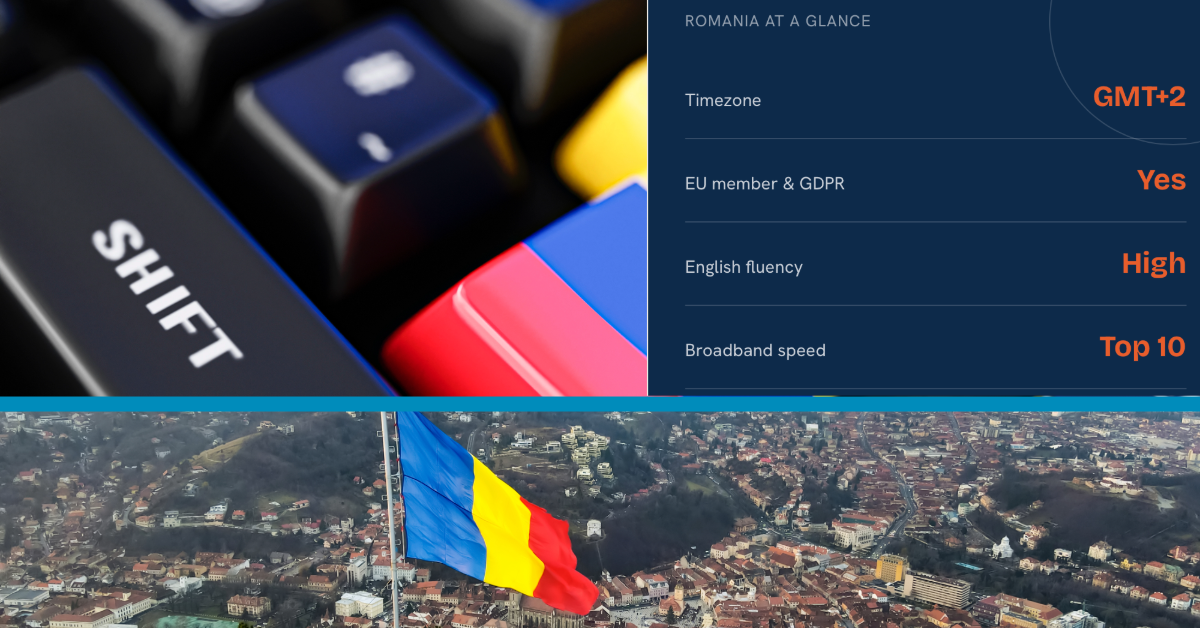
What makes Romania the complete package isn’t any single factor. It’s the combination: a strong technical education system, real multilingual fluency, EU membership, competitive rates, and a timezone that overlaps both Europe and the US.

The result is the rare outsourcing relationship that feels like an extension of your own team – not a hand-off to a distant vendor across an awkward time gap.

What makes Romania a top outsourcing destination

A deep, renewing talent pool: Romanian universities graduate tens of thousands of engineers each year, many specialising in ICT. It’s one of Europe’s largest pools of certified IT professionals and it refreshes annually, so seniority and scale are both available.

Strategic location & timezone: Situated in Central-Eastern Europe on GMT+2, Romania overlaps the European and US working day for real-time collaboration. Bucharest is a short direct flight from London, Paris, Frankfurt and Amsterdam, with visa-free travel inside the EU.

Language & cultural fit: Engineers work in English by default, with strong French, German and other European languages common. A Western work culture and communication style means teams integrate smoothly, which implies fewer misunderstandings and faster delivery.

Cost-efficiency with quality: Rates sit well below Western Europe and the US, but the seniority doesn’t. You’re trading location cost only, not engineering standards, which is exactly what makes the value sustainable rather than a short-term saving.

EU membership, GDPR & IP security: As an EU member, Romania offers data protection, intellectual-property security and legal certainty inside the European framework — not the grey zone that comes with far-shore jurisdictions.

World-class connectivity: Romania ranks among the world’s best for high-speed broadband, supporting seamless remote collaboration. A dense, mature tech ecosystem spans Bucharest, Cluj-Napoca, Timișoara and Iași.

Pick the model – we bring the talent

Whether you want engineers inside your team or a project delivered end to end, the foundation is the same senior Romanian talent pool. We at Zeren can help you in many days – from staff augmentation to dedicated teams, Build-Operate-Transfer to time & material or software development.

Categories
Artificial Intelligence Case study

Romania and Bulgaria are EU’s AI Readiness Laggards

Romania and Bulgaria are EU’s AI Readiness Laggards

A new peer-reviewed study maps AI readiness across all EU member states. The findings are blunt: Southern and Eastern Europe – and Romania in particular – face systemic barriers that go far deeper than infrastructure or investment. Here is what the research says, and what needs to change.

This should not be surprising. For years, analyses of the EU’s digital landscape have pointed to the same fault line – a persistent gap between Northern and Western European member states on one side, and Southern and Eastern ones on the other. Lower levels of digital and AI literacy, slower e-government adoption, educational disparities, weaker institutional capacity: the diagnosis is familiar.

What is new — and what should prompt genuine concern — is the specific nature of the deficit now being quantified. A 2026 peer-reviewed study published in Telematics and Informatics on ScienceDirect (“Unequal AI readiness: institutional and digital disparities in e-government across the European Union”) does not merely describe a digital divide. It maps, clusters, and names the countries that are structurally unprepared for artificial intelligence in public governance.

Romania and Bulgaria appear in the worst-performing cluster. The study calls them AI Readiness Laggards.

“Extremely low levels of digital skills, suggesting systemic barriers to AI readiness.”

What the study actually measures

Unlike broader digital economy indices, this study focuses specifically on the prerequisites for AI adoption in e-government — the machinery of public services and state institutions. The researchers identify two independent and underlying dimensions that determine whether a country is ready for AI-driven governance:

  1. Digital Skills & E-Government Engagement – Measures citizen-side readiness: the prevalence of digital competencies in the general population and the degree to which citizens actually interact with government digitally.
  2. Transparency & E-Government Service Availability – Measures institution-side readiness: how openly and completely public services are delivered digitally, and the transparency of government operations and data.
How the EU clusters

The study identifies six distinct clusters of member states based on their combined scores across the two dimensions. The distribution is uneven, and the gap between the best and worst performers is stark.

On one side, the AI – Ready Leaders: High digital skills. High transparency. A self-reinforcing cycle: skilled citizens demand better services; better services built more skilled citizens. Institutions here are the closest to being operationally ready for AI in governance. Here you can find countries like Denmark, Finland, The Netherlands.

On the other side, the AI Readiness Laggards: Low digital skills. Low transparency. Systemic, not surface-level, barriers. Extremely low digital skills in the general population combined with limited institutional transparency creates a compound readiness deficit. Here you can find countries like Romania or Bulgaria.

What Romania must do – and where to start

The study does not prescribe solutions, but the diagnosis makes the priorities clear. Closing the AI readiness gap requires action on multiple levels simultaneously, because the two dimensions interact: you cannot build institutional AI capacity without a population that can engage with digital public services, and you cannot drive citizen digital literacy without better, more transparent digital services to engage with.

Our view

At Zeren Software, we work at the intersection of digital transformation, software development, and institutional capacity. The study’s findings confirm what we observe in our client work across the region: the barriers to AI readiness are organisational and human before they are technical. Procuring AI tools is not the same as being ready to use them. Writing a national AI strategy is not the same as having the institutional infrastructure to implement it.

Romania can close this gap. But it requires treating digital literacy and institutional transparency not as outputs of AI adoption, but as the prerequisites for it. The study makes clear that the countries which are genuinely ready started building those prerequisites long before AI became the policy priority it is today.

The readiness gap is a shared problem. Closing it requires pressure and example also from the private sector, not just government initiative.