IT Outsourcing to Romania: Everything You Need To Know
Senior engineers, real-time collaboration, EU-grade security and cost-efficiency in one of Europe’s deepest tech talent markets. Here’s why the world’s product teams build here, and how Zeren helps you do it.
A go-to answer to the talent shortage without the trade-offs.
Across every industry, the same pressure shows up: more software to build than people to build it. IT outsourcing has become the standard response. A way to address skills shortages while keeping cost and quality in balance.
For more than fifteen years, Romania has been one of the most trusted places to do exactly that. Major global companies run engineering operations here, and a steady flow of new specialists keeps the talent market deep and renewing.
What makes Romania the complete package isn’t any single factor. It’s the combination: a strong technical education system, real multilingual fluency, EU membership, competitive rates, and a timezone that overlaps both Europe and the US.
The result is the rare outsourcing relationship that feels like an extension of your own team – not a hand-off to a distant vendor across an awkward time gap.
What makes Romania a top outsourcing destination
A deep, renewing talent pool: Romanian universities graduate tens of thousands of engineers each year, many specialising in ICT. It’s one of Europe’s largest pools of certified IT professionals and it refreshes annually, so seniority and scale are both available.
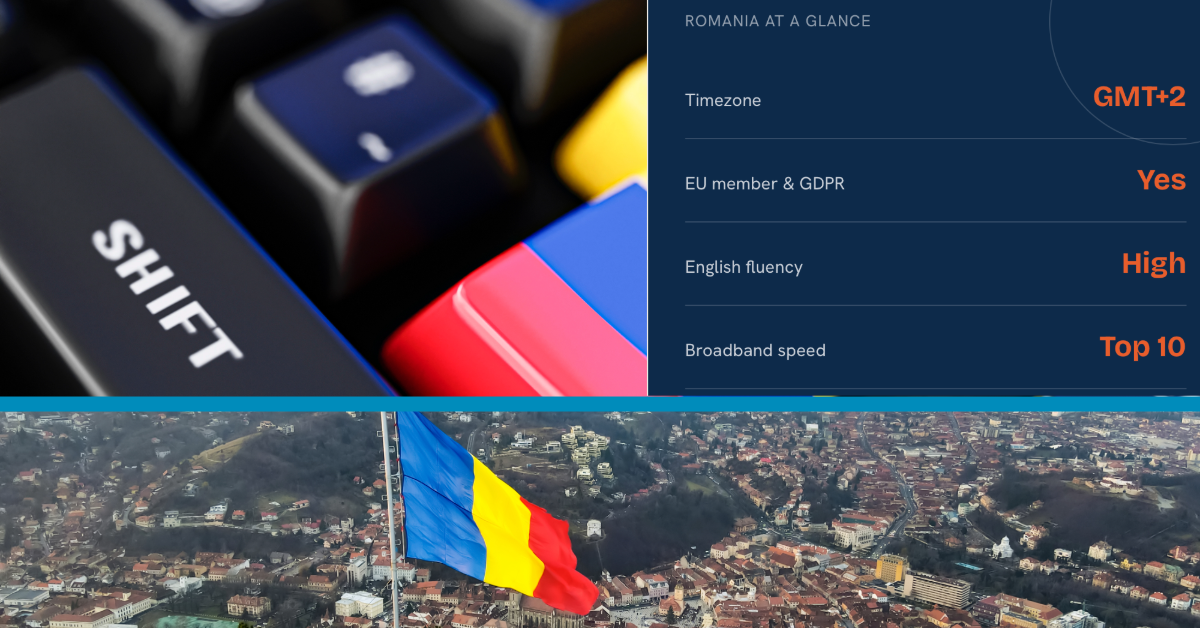
Strategic location & timezone: Situated in Central-Eastern Europe on GMT+2, Romania overlaps the European and US working day for real-time collaboration. Bucharest is a short direct flight from London, Paris, Frankfurt and Amsterdam, with visa-free travel inside the EU.
Language & cultural fit: Engineers work in English by default, with strong French, German and other European languages common. A Western work culture and communication style means teams integrate smoothly, which implies fewer misunderstandings and faster delivery.
Cost-efficiency with quality: Rates sit well below Western Europe and the US, but the seniority doesn’t. You’re trading location cost only, not engineering standards, which is exactly what makes the value sustainable rather than a short-term saving.
EU membership, GDPR & IP security: As an EU member, Romania offers data protection, intellectual-property security and legal certainty inside the European framework — not the grey zone that comes with far-shore jurisdictions.
World-class connectivity: Romania ranks among the world’s best for high-speed broadband, supporting seamless remote collaboration. A dense, mature tech ecosystem spans Bucharest, Cluj-Napoca, Timișoara and Iași.
Pick the model – we bring the talent
Whether you want engineers inside your team or a project delivered end to end, the foundation is the same senior Romanian talent pool. We at Zeren can help you in many days – from staff augmentation to dedicated teams, Build-Operate-Transfer to time & material or software development.