
Categories
Agile Development Artificial Intelligence Case study Staff Augmentation Uncategorized

The Future of Tech Talent and Four Scenarios for the World of 2050

The Future of Tech Talent and Four Scenarios for the World of 2050

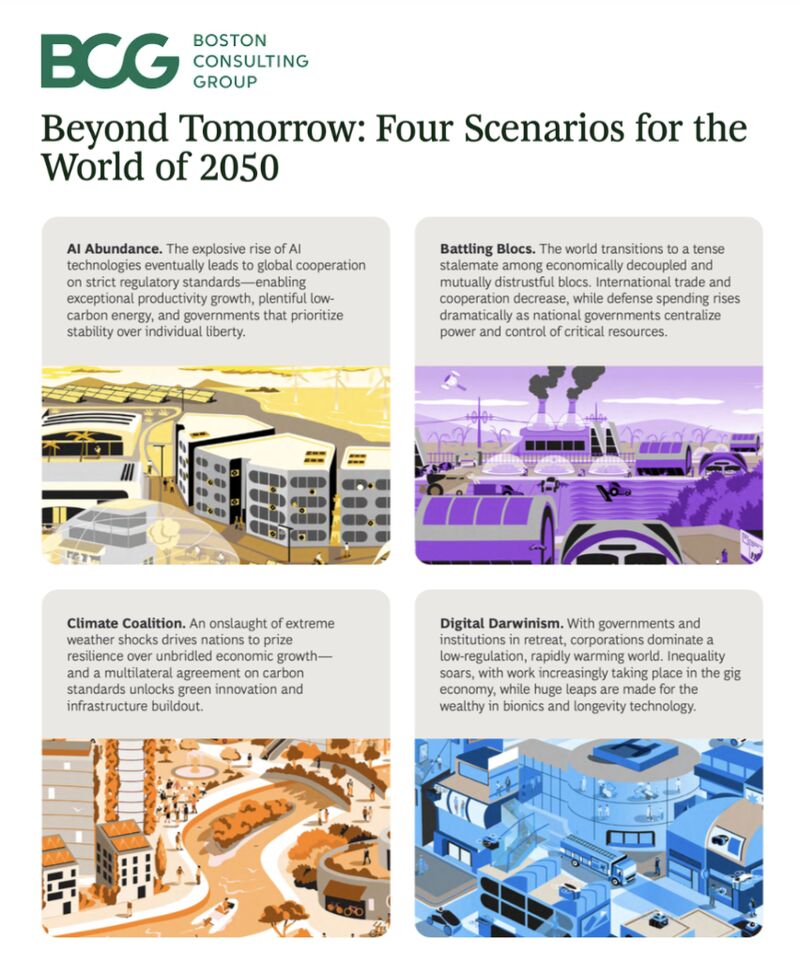
AI Abundance. Battling Blocs. Climate Coalition. Digital Darwinism. The BCG Henderson Institute gave the next 25 years four names – and every one of them rewrites how companies will hire, skill, and access the people who build their tech environments.

Most strategy still runs on a single, unspoken assumption: that tomorrow will look roughly like today, only more so. The BCG Henderson Institute’s report, Beyond Tomorrow: Four Scenarios for the World of 2050, makes the case that this is the one assumption no leader can afford.  The only unacceptable strategy is planning for just one future.

BCG built the four scenarios on a quantitative analysis of more than a hundred megatrends, a century of historical data, and dozens of expert interviews, then stress-tested each across twenty economic, geopolitical, societal, and environmental metrics. These scenarios are a map of the plausible – and the spread between them is staggering.

At Zeren, we read futures work like this through one lens: talent. Because whichever of these four worlds we drift toward, each one reshapes the most important question our industry answers – how do companies get the right capabilities, in the right place, at the right moment? Here are the four scenarios in full, followed by what they mean for hiring and IT staff augmentation specifically.

1. AI Abundance – the regulated boom

The world. AI explodes, nearly breaks society, and is then reined in by global cooperation. In BCG’s telling, a wave of AI-enhanced cyberattacks in the 2030s – the “Compute Wars” – cripples hospitals, grids, and transport, affecting more than a billion people.

The result by 2050 is a genuine productivity miracle. Global GDP more than triples, driven not by population or globalization but by soaring productivity – high-income labor productivity grows at roughly 5.7% a year. Clean energy becomes cheap and plentiful, a robotics and “physical AI” revolution transforms manufacturing and services, and the average person works about 25% fewer hours than today – roughly 1,600 a year, down from 2,100, with four-day weeks common in many regions. Healthy life expectancy climbs from 63 to 70. Most nations build expanded safety nets or basic-income programs funded by automation taxes.

The catch is freedom. To combat misinformation, guardrails on digital platforms constrain civil society; governments quietly trade some individual liberty for stability. And the climate is hot – around 2.2°C above pre-industrial levels — though emissions are finally falling fast.

The tech talent earthquake. AI and robots displace much of what people used to do, and the wage premium for expertise erodes across many professions. New opportunity concentrates in three places: caring professions, AI oversight and judgment roles, and skilled manual trades. BCG’s sharpest warning is the rise of AI-only firms – networks of specialized AI agents that run with little or no human involvement, and that appear first in digital-native sectors with minimal physical interface: software development, digital marketing, algorithmic trading. In other words, Zeren’s industry’s heartland.

2. Battling Blocs – the fractured world

The world. Globalization goes into reverse. After a tariff war, a wave of nationalist leaders, splintering of the internet, the collapse of the WTO, and the hollowing-out of the UN, the world hardens into rigid, mutually distrustful blocs that prize security and self-sufficiency over collaboration. Trade falls back to Cold War levels — from 57% of global GDP to 35%. Defense spending nearly triples, from 2.4% to 7% of GDP.

The line between government and business blurs into state capitalism. Traditional multinationals all but disappear, forced to pick a bloc or juggle a fragile web of regional joint ventures. Innovation narrows to defense, dual-use technology, and bloc self-reliance, while consumer and health domains starve for investment. Growth stalls at 1.8% a year, productivity at just 1.0%. Democracies fall from 49% of countries to 25%. Worldwide happiness drops 10%, extreme poverty rises from 8% to 10%, and with multilateral climate action dead, warming still reaches 2.1°C.

The tech talent earthquake. This is the scenario where BCG states it most directly: talent becomes a scarce strategic asset and a dimension of great-power competition. Aging populations and restricted migration tighten labor markets; immigration policy shifts from a growth lever to a geostrategic weapon. The race for talent plays out across three fronts – capturing scientific and technical expertise, sustaining entrepreneurial clusters, and protecting the academic centers that train the next generation. Meanwhile, a non-aligned Global South – India projected to be the world’s third-largest economy by 2029, with Brazil, Indonesia, and others climbing fast – becomes a coveted source of young, expanding workforces.

3. Climate Coalition — resilience over growth

The world. A run of extreme weather events in the late 2020s – catastrophic flooding, deadly heat waves – triggers a global wave of citizen pressure for coordinated action. A “climate club” of industrial nations forms, requiring members to price carbon domestically and apply carbon border adjustments. By 2040 most major economies have joined; by 2050 carbon sells at $300 a ton. It works: warming stabilizes at 1.8°C, the share of unabated fossil fuels in the energy mix collapses from 81% to 35%, and low-carbon sources generate 92% of electricity.

But it’s a delicate balance. Taxes are high and spending is lean. Growth is slow but steady at 2.5% a year, dragged by aging societies and the fading dividends of globalization. The upside is broadly shared – extreme poverty is halved, from 8% to 4%. The friction is generational: with carbon revenues earmarked for restoration and pension liabilities heavy, working-age adults in advanced economies end up with less disposable income than retirees, and politics turns on intergenerational fairness.

The tech talent earthquake. Crucially, in this world AI is a support for humans, not a substitute – job losses happen, but they’re temporary because nations and companies invest continuously in upskilling and reskilling. Innovation pours into low-carbon energy, new materials, biotech, and agriculture, creating demand for entirely new skill profiles. And aging hits hard: labor shortages spread across the Global North, making aging-workforce strategy – late-career pathways, multigenerational teams, knowledge transfer between older and younger workers – a frontline competitive issue rather than an HR footnote.

4. Digital Darwinism — survival of the fittest

The world. The opposite of AI Abundance’s bargain. A race to the bottom on regulation unleashes tech companies, governments retreat, and a survival-of-the-fittest ethos takes hold. Growth is strong – global GDP grows 4% a year, near-tripling – and trade stays open out of commercial self-interest (61% of GDP). But the spoils are brutally concentrated: the richest 1% come to hold nearly half of global wealth, a level not seen since the early 1900s, while the middle class shrinks and extreme poverty climbs from 8% to 12%.

Work fractures into two tiers. Those with creative or high-skill expertise thrive; everyone else faces stagnant prospects, gig-style and short-term contracts mediated by algorithmic platforms, AI “cobots” that double as surveillance, and an epidemic of digital overload, burnout, and addiction. Knowledge gets locked inside megacorporations, eventually dampening the pace of innovation. Democracies fall to 30% of countries. With decarbonization sidelined for adaptation that mostly protects wealthy enclaves, warming hits 2.5°C.

The tech talent earthquake. This is the staff-augmentation model taken to a dystopian extreme: contingent, algorithmically-brokered, commoditized labor at civilizational scale, stripped of security and stability. In a low-trust, cutthroat environment, BCG argues that trust itself — auditable governance, provenance, cyber resilience, genuine investment in people — becomes one of the few durable differentiators. Multitier offerings emerge everywhere: premium for the elite, bare-bones for the mass market.

What the four scenarios mean for hiring and IT staff augmentation

Read together, the four worlds deliver a striking verdict for our industry: the demand for flexible, on-demand access to specialized talent doesn’t just survive in every scenario – it intensifies.

In AI Abundance, the commodity layer evaporates — and the judgment layer becomes gold. If AI-only firms can spin up in software development and digital marketing first, then supplying generic “three backend developers for six months” is the part of our business most exposed to automation. But the same scenario tells us exactly where human value migrates: agenda-setting, taste, assessment, oversight, empathy, and the orchestration of agentic workflows. The staff augmentation that wins here doesn’t sell seats; it sells AI-fluent architects, human-in-the-loop judgment, and the embedded leadership that helps a client become AI-first before an AI-only rival makes the choice for them. Reskilling stops being a perk and becomes the core product.

In Battling Blocs, location becomes destiny — and within-bloc nearshore talent becomes a strategic asset. When mobility tightens and data localizes, a client can no longer freely tap a global talent pool. They need capability inside their own bloc and jurisdiction. For an EU-anchored, Romania-based partner, this is structurally favorable: deep engineering talent, nearshore proximity to Western European clients, and shared regulatory ground at exactly the moment those things become scarce and valuable. The flip side is real — fragmentation makes cross-border sourcing harder and turns talent access into a geopolitical question — but in a bloc-based world, being inside the right bloc with the right people is a moat, not a footnote.

In Climate Coalition, the mandate is reskilling and demographics. Continuous upskilling is explicitly what keeps job losses temporary in this world, and chronic labor shortages across an aging Global North create durable, structural demand for flexible and specialized talent. Add the green-skills gap — climate-tech, energy software, MRV and carbon-accounting systems, new-materials engineering — and you have a market that needs partners who can both close skill gaps fast and design multigenerational, late-career-inclusive workforce models. This is the scenario most aligned with staff augmentation as a strategic capability rather than a stopgap.

In Digital Darwinism, trust is the only defensible margin. This world commoditizes contingent labor and pushes the whole industry toward a price-driven, platform-brokered race to the bottom – with worker wellbeing as collateral damage. The firms that don’t get commoditized are the ones that invest in the opposite: rigorous vetting, embedded delivery leadership, auditable quality, and a genuine duty of care to the people they place. The “pod and squad” model – cross-functional teams with embedded tech leads and delivery managers who own outcomes – is precisely the antidote to anonymous gig brokering. In a low-trust world, being the trusted name is the premium.

The through-line: BCG’s five low-regret moves

Across all four scenarios, BCG identifies five “low-regret” moves that make sense no matter which future arrives. One of them reads almost like a job description for the next era of our industry:

Reimagine talent for aging populations and AI – build models for intergenerational word, more flexible roles, and talent mobility; extend your talent footprint into emerging labor markets; and design new human-machine operating models that combine agentic AI workflows with human oversight, judgment, and creativity.

The other four reinforce the same direction of travel. Enhance structural resilience (diversify, build regional optionality). Build digital flexibility and trust (modular stacks, cybersecurity, verifiable systems). Sharpen sensing and influencing (foresight, faster decision loops). And embrace a broader societal role — because companies that look after workers’ wellbeing will, in BCG’s words, earn a premium in talent markets.

That last point matters most for an industry built on people. In a world where skills expire faster than ever and adaptability beats permanence in every scenario, the organizations that treat talent as a strategic system — not a cost line — are the ones positioned to win.

Where Zeren stands

Strip the four scenarios down to their common core and two truths hold in every one:

First, the half-life of skills keeps shrinking. Whether AI augments work, fragments it, greens it, or commoditizes it, no one builds a 2050-proof workforce by hiring once and standing still. Reskilling, redeployment, and flexible access to specialized tech capability move from “nice to have” to the center of workforce strategy.

Second, the value of getting the right tech capability, exactly when you need it rises in all four futures. That has always been the premise of staff augmentation – and these scenarios suggest the premise only gets stronger. What they also make clear is where the work has to move: up the value chain. Away from filling seats and toward outcome-aligned pods, embedded leadership, AI-fluent talent, and a trust standard that a platform can’t replicate.

That’s the bet we’re already making. We build tech talent models backwards from outcomes rather than forwards from job titles. We deploy cross-functional pods rather than scattered individuals. We treat embedded tech leads and delivery managers as the multiplier, not the overhead. And we work at the intersection of tech talent and human potential – because in every one of BCG’s four worlds, that intersection is exactly where durable advantage lives.

You can’t plan for a single version of 2050. But you can build the one capability that pays off in all of them: the ability to access, shape, and continually renew the tech talent your strategy depends on. That’s the future we’re preparing our clients — and ourselves — to thrive in.


Source: BCG Henderson Institute, “Beyond Tomorrow: Four Scenarios for the World of 2050” (April 2026). All scenario data and projections are BCG’s; the talent and staff-augmentation analysis is Zeren Software’s own.

Categories
Case study News Uncategorized

Technology – Shifting from a Cost Center to a Value Creator

Technology – Shifting from a Cost Center to a Value Creator

Some companies still treat technology as a cost center,  others treat it as a growth engine.

McKinsey released their Global Tech Agenda 2026 back in February, surveying 632 C-level executives across 69 countries.

Key Findings

Here’s what separates the top performers:

Nearly 2/3 of top-performing companies have their technology leaders “very involved” in crafting enterprise strategy – vs. just 52% of other organizations.

Half of top performers now co-create strategy between business and tech teams continuously throughout the year – nearly double the rate from last year.

28% of top performers were planning to increase their tech budgets by more than 10% in 2026.

More than half of top performers have already transformed their IT function using AI in the past two years.

Forward-thinking CIOs are investing in agentic automation to change how business gets done and in data productization to generate entirely new revenues.

They are replacing annual budget planning with practices that fuel innovation – i.e. product and platform models, continuous decision-making, engineering excellence, and capability-led talent models.

The #1 investment priority is obviously Artificial Intelligence. And this has now surpassed cybersecurity and infrastructure as the top technology investment area.

We already see leaders building in-house capabilities, reskilling their own people, and weaving AI into decision-taking.

Vision for the future

We can find thousands of IT stories out there. But very few still are business transformation stories like, for instance, Aviva. They deployed 80+ AI models across their claims journey. This is how they reduced liability-assessment time by 23 days, cut customer complaints by 65%, and increased their customer satisfaction score sevenfold.

At top-performing companies, technology’s center of gravity has shifted from a cost center to a value creator.

What about you? Are you writing the AI story as we speak? Is your technology leader shaping your company’s future – or just keeping the lights on?

Categories
Artificial Intelligence Case study Uncategorized

Why your AI agents keep failing – and it’s not AI

Why your AI agents keep failing – and it’s not AI

Most companies experimenting now with AI agents never manage to scale them. Fewer than one in ten do. The problem, almost always, is what’s underneath: the data.

The gap everyone is trying not to talk about

So, there’s a version of the AI story that sounds like this: companies deploy AI agents, the agents automate complex tasks, productivity soars, and everyone wins. That version exists. It’s just rarer than the headlines suggest.

In other words, according to a McKinsey study published in April 2026, roughly two thirds of enterprises worldwide have run experiments with AI agents. Fewer than ten percent have managed to scale them into something that delivers real, measurable value. And the failure isn’t usually the AI itself – it’s what the AI is running on.

“Eight in ten companies say fragmented, siloed data is what stops them from scaling AI agents.”

What good foundations actually look like

Actually, McKinsey’s research identifies four steps that separate organisations managing to scale agentic AI from those who get stuck in pilot purgatory. They’re worth understanding as a sequence – each one builds on the last.

  1. Find the right workflows to automate. Not everything benefits from an AI agent. The organisations getting results start by identifying a small number of end-to-end processes where autonomous decision-making could genuinely change outcomes – and map exactly what data those processes would need.
  2. Clean up the data architecture, layer by layer. This doesn’t mean rebuilding everything from scratch, it actually means modernising how data flows, connects, and becomes usable – progressively. Thus, data from different systems (CRM, supply chain, finance) needs to speak the same language.
  3. Move from cleanup sprints to continuous quality management. One of the most common failure modes is treating data quality as a periodic project. In an agentic environment, we should be able to monitor data quality in real time, with automated checks.
  4. Build governance for what agents are allowed to do. As agents gain autonomy, the rules governing their behaviour become the primary mechanism of control. Clear policies – defining what data an agent can access need to be automated and embedded. Human roles shift from doing the work to supervising and orchestrating agent-driven workflows.

Not to mention that the thread running through all four steps is the same: we need to treat data as infrastructure.

Where Zeren fits into this picture

In fact, this is the layer of work Zeren’s consultants operate in. We have consultants like Sânziana for whom the data architecture makes the AI models reliable.

Sânziana, one of Zeren’s senior data architects, is currently leading a Business Intelligence engagement for a major manufacturing company in the Nordics. Her framing of the problem captures it well:

“Without properly modelled data, AI cannot produce good results. We are among the fortunate ones for whom the rise of AI brings more work, not less.”

What Zeren Software does

Nevertheless, Zeren connects specialist data professionals – data architects, data engineers, BI consultants, AI engineers – with complex international projects. Our consultants work across industries building the data foundations that make AI actually usable in production environments.

The question worth asking now

So, if your organisation is planning an AI initiative, the most useful diagnostic relates to the data underneath the AI model. Is it connected or consistent? Is it governed? Do your agents have access to what they need, and only what they need? All these are questions to consider.

“In the agentic age, data foundations are becoming the primary source of competitive differentiation.”

Undoubtedly, for the companies already operating at scale, this prediction is already a sheet fact.

Curious about how your data infrastructure stacks up? Get in touch with Zeren.

Categories
Artificial Intelligence Case study

Romania and Bulgaria are EU’s AI Readiness Laggards

Romania and Bulgaria are EU’s AI Readiness Laggards

A new peer-reviewed study maps AI readiness across all EU member states. The findings are blunt: Southern and Eastern Europe – and Romania in particular – face systemic barriers that go far deeper than infrastructure or investment. Here is what the research says, and what needs to change.

This should not be surprising. For years, analyses of the EU’s digital landscape have pointed to the same fault line – a persistent gap between Northern and Western European member states on one side, and Southern and Eastern ones on the other. Lower levels of digital and AI literacy, slower e-government adoption, educational disparities, weaker institutional capacity: the diagnosis is familiar.

What is new — and what should prompt genuine concern — is the specific nature of the deficit now being quantified. A 2026 peer-reviewed study published in Telematics and Informatics on ScienceDirect (“Unequal AI readiness: institutional and digital disparities in e-government across the European Union”) does not merely describe a digital divide. It maps, clusters, and names the countries that are structurally unprepared for artificial intelligence in public governance.

Romania and Bulgaria appear in the worst-performing cluster. The study calls them AI Readiness Laggards.

“Extremely low levels of digital skills, suggesting systemic barriers to AI readiness.”

What the study actually measures

Unlike broader digital economy indices, this study focuses specifically on the prerequisites for AI adoption in e-government — the machinery of public services and state institutions. The researchers identify two independent and underlying dimensions that determine whether a country is ready for AI-driven governance:

  1. Digital Skills & E-Government Engagement – Measures citizen-side readiness: the prevalence of digital competencies in the general population and the degree to which citizens actually interact with government digitally.
  2. Transparency & E-Government Service Availability – Measures institution-side readiness: how openly and completely public services are delivered digitally, and the transparency of government operations and data.
How the EU clusters

The study identifies six distinct clusters of member states based on their combined scores across the two dimensions. The distribution is uneven, and the gap between the best and worst performers is stark.

On one side, the AI – Ready Leaders: High digital skills. High transparency. A self-reinforcing cycle: skilled citizens demand better services; better services built more skilled citizens. Institutions here are the closest to being operationally ready for AI in governance. Here you can find countries like Denmark, Finland, The Netherlands.

On the other side, the AI Readiness Laggards: Low digital skills. Low transparency. Systemic, not surface-level, barriers. Extremely low digital skills in the general population combined with limited institutional transparency creates a compound readiness deficit. Here you can find countries like Romania or Bulgaria.

What Romania must do – and where to start

The study does not prescribe solutions, but the diagnosis makes the priorities clear. Closing the AI readiness gap requires action on multiple levels simultaneously, because the two dimensions interact: you cannot build institutional AI capacity without a population that can engage with digital public services, and you cannot drive citizen digital literacy without better, more transparent digital services to engage with.

Our view

At Zeren Software, we work at the intersection of digital transformation, software development, and institutional capacity. The study’s findings confirm what we observe in our client work across the region: the barriers to AI readiness are organisational and human before they are technical. Procuring AI tools is not the same as being ready to use them. Writing a national AI strategy is not the same as having the institutional infrastructure to implement it.

Romania can close this gap. But it requires treating digital literacy and institutional transparency not as outputs of AI adoption, but as the prerequisites for it. The study makes clear that the countries which are genuinely ready started building those prerequisites long before AI became the policy priority it is today.

The readiness gap is a shared problem. Closing it requires pressure and example also from the private sector, not just government initiative.


Categories
Agile Development Artificial Intelligence Case study Cloud Custom Software News Staff Augmentation

Partnership Extension Announcement | Delivering Core Tech Foundations in the Insurance Sector

Partnership Extension Announcement | Delivering Core Tech Foundations in the Insurance Sector

We’re excited to announce that our collaboration with one of our trusted technology partners is growing, as we continue to support a long-term project for a leading insurance company based in Scotland.

Since July last year, Zeren consultants have been part of a foundational engineering group that plays a critical role in enabling three distinct product teams across the organization. We’re proud to see this collaboration expand, with the project’s scope broadened as a result of positive client feedback.

Our team contributes to the delivery and evolution of core internal services, including:

✅ Authentication and authorization systems
✅ Cloud-based data storage using Microsoft Azure
✅ Development of internal APIs that abstract and streamline access to underlying services

This recent extension stands as a testament to the value of close collaboration, technical ownership, and the lasting impact of a strong engineering foundation at scale.
We’re grateful for the ongoing trust and excited to keep building together.

Categories
Case study Data Engineering

New Partnership Announcement: Strengthening Our BI & Data Engineering Team

New Partnership Announcement: Strengthening Our BI & Data Engineering Team

We are excited to announce the expansion of our team in the Business Intelligence (BI) and Data Engineering sector, bringing on board exceptional expertise in Migration from On-Premise to Cloud solutions. This expansion comes as we embark on a new collaboration with one of our esteemed Nordic clients — a global leader in vehicle manufacturing, for which we have been working for the last three years.

The project will focus on delivering advanced development in Snowflake, dbt, and Power BI, with an emphasis on data engineering and database management. Our consultant, S.I.T., has demonstrated exceptional analytical skills throughout the selection process, impressing our client with her technical acumen, leadership capabilities, and strong communication skills. Her ability to think critically and solve complex problems, paired with a deep passion for creating innovative solutions, ensures the delivery of top-notch results in data analysis and reporting.

This successful partnership marks an important milestone for Zeren Software, as we continue to grow our team to meet the needs of our clients. We are thrilled to see our proposal be so well received and look forward to starting the project in April. Our commitment to ensuring our customer’s success remains steadfast, and we are excited to contribute to their continued growth and innovation.

Stay tuned for more updates from Zeren Software!

Categories
Case study Cyber Security Data Engineering IT Project Management Staff Augmentation

Tech Skills for the Future: Preparing for 2025 and Beyond

Tech Skills for the Future: Preparing for 2025 and Beyond

The technology landscape is evolving at an unprecedented pace, reshaping industries and creating demand for new skills. As businesses adopt cutting-edge solutions like AI, quantum computing, and cloud services, IT professionals must adapt to stay relevant. Zeren Software goes beyond building teams for today’s challenges—we’re equipping them for the demands of tomorrow. Here’s a deep dive into the tech skills that will dominate the IT world in 2025 and beyond—and why these skills are critical for businesses aiming to thrive in the future.

1. Cloud Engineering and Architecture

The global shift to cloud-first strategies is accelerating, with businesses increasingly moving their operations to platforms like AWS, Microsoft Azure, and Google Cloud. The demand for cloud engineers is surging as companies rely on experts to design, deploy, and manage their cloud infrastructure.

Cloud engineers aren’t just responsible for keeping systems running—they optimize resources, ensure scalability, and maintain robust security protocols. As hybrid and multi-cloud environments become more prevalent, proficiency in cloud orchestration, containerization (Kubernetes, Docker), and cost management tools will be indispensable.

Zeren’s teams are built to help clients unlock the full potential of the cloud. From migrations to custom cloud-native solutions, our experts enable businesses to innovate faster and scale smarter.

2. AI Ethics and Responsible AI

Artificial intelligence is no longer a futuristic concept—it’s embedded in everyday processes, from customer service chatbots to financial decision-making systems. However, the rapid adoption of AI has raised critical questions about ethics. How can organizations ensure their AI systems are unbiased, transparent, and fair?

Skills in AI ethics are becoming essential for IT professionals, particularly in industries where regulations demand accountability. Expertise in responsible AI development, bias mitigation, and algorithmic transparency will be in high demand.

Our approach to AI ensures businesses can leverage this technology responsibly. Zeren equips teams to design and implement AI systems that not only meet technical requirements but also adhere to ethical and regulatory standards.

3. Quantum Computing Expertise

Quantum computing, a field once confined to research labs, is nearing practical application. The ability to solve complex problems exponentially faster than traditional computers has enormous implications for industries like healthcare, finance, and logistics.

Professionals skilled in quantum algorithms, quantum machine learning, and post-quantum cryptography will be at the forefront of this revolution. While still an emerging technology, the groundwork for quantum computing’s widespread adoption is being laid today.

Zeren prepares its teams to monitor and adapt to quantum advancements, ready to integrate quantum-ready solutions as this transformative technology becomes accessible.

4. Cybersecurity and Zero-Trust Models

As cyber threats become more sophisticated, cybersecurity has evolved from being a technical necessity to a strategic priority. The traditional perimeter-based security model is being replaced by zero-trust architectures, which assume that no user or device can be trusted without verification.

IT professionals skilled in implementing zero-trust frameworks, cloud security, and AI-driven threat detection will be indispensable. Additionally, as IoT devices proliferate, securing these endpoints will become a critical focus area.

Our cybersecurity teams at Zeren work to help businesses adopt the latest security measures. Whether it’s securing cloud infrastructure or safeguarding IoT ecosystems, we ensure clients stay protected in an increasingly interconnected world.

5. Data Analytics and Machine Learning (ML)

The explosion of data in recent years has made advanced analytics and machine learning pivotal to business success. Companies need professionals who can turn vast amounts of raw data into actionable insights, using tools like TensorFlow, PyTorch, and advanced visualization platforms.

Machine learning engineers and data scientists who can design predictive models, automate processes, and provide data-driven recommendations will continue to be highly sought after.

We prioritize building teams capable of creating robust data strategies that allow businesses to uncover trends, optimize operations, and gain a competitive edge.

6. DevOps and Automation

Automation has become a cornerstone of IT operations, and DevOps practices are essential for achieving seamless collaboration between development and operations teams. Professionals who understand continuous integration/continuous deployment (CI/CD) pipelines, infrastructure as code (IaC), and automated testing frameworks will remain in high demand.

Through streamlined workflows and reliable tools, Zeren’s specialists ensure businesses can deliver faster, more scalable, and cost-efficient solutions while minimizing operational burdens.

How Forward-Thinking Teams Prepare for the Future

Staying competitive in the future of IT requires more than keeping pace—it demands foresight and adaptability. Zeren Software is committed to equipping teams with the skills and knowledge to thrive in an ever-changing industry. By fostering continuous learning, upskilling, and real-world application of emerging technologies, we ensure our teams are always prepared to deliver innovation.

From navigating quantum computing to implementing robust security frameworks, we enable businesses to capitalize on opportunities while overcoming technical challenges.

Conclusion

The IT skills of the future reflect the rapidly evolving demands of a digital-first world. As businesses seek to stay competitive, investing in these high-demand skills—cloud engineering, AI ethics, quantum computing, cybersecurity, and more—will be crucial.

We aren’t just responding to trends; we’re leading them. At Zeren Software, our mission is to unlock the full potential of every business by building teams ready for tomorrow.

Ready to future-proof your IT capabilities? Let’s build the next generation of IT solutions together.

Categories
Artificial Intelligence Case study IT Project Management News

How Zeren Ensures Success in an Era Where 80% of AI Projects Fail

How Zeren Ensures Success in an Era Where 80% of AI Projects Fail

Artificial Intelligence (AI) is rapidly transforming industries, promising unprecedented efficiencies, insights, and innovation. However, according to a recent article in the Harvard Business Review, up to 80% of AI projects fail to reach their intended goals. This sobering statistic raises a critical question: how can organizations ensure their AI initiatives succeed?

At Zeren, we understand the challenges inherent in AI project implementation. From the complexities of data management to the need for specialized skills, launching a successful AI initiative requires more than just cutting-edge technology. It demands a holistic approach combining best practices, expert project management, and tailored consultancy. Here’s how Zeren ensures that our clients don’t just participate in the AI revolution—they lead it.

Best Practices: The Foundation of Success

Successful AI projects are built on a foundation of best practices, which are integral to every stage of development at Zeren. Our team follows a proven framework that begins with a deep understanding of the client’s business objectives. We know that AI solutions must align with broader strategic goals to deliver tangible results.

Moreover, we emphasize the importance of data quality and governance. AI models are only as good as the data they are trained on. At Zeren, we employ rigorous data validation processes to ensure the accuracy, consistency, and reliability of the data that powers AI models. This attention to detail minimizes the risk of biases and errors, leading to more accurate predictions and insights.

Project Management: Steering AI to Success

Even with the best technology and data, AI projects can still falter without effective project management. Zeren’s project management approach is designed to navigate the complexities of AI initiatives, ensuring they are delivered on time, within budget, and with the desired outcomes.

Our project managers are not just coordinators—they are AI-savvy professionals who understand the technical intricacies of AI. They work closely with clients to set realistic timelines, manage expectations, and adjust strategies as needed. By maintaining clear communication and a focus on objectives, our project managers keep AI projects on track, reducing the risk of failure.

Tailored Consultancy: Expertise That Drives Value

Zeren’s consultancy services are tailored to each client’s unique needs, ensuring that AI initiatives are not just technically sound but also strategically aligned. We begin by conducting a thorough assessment of the client’s current capabilities and future goals. This allows us to design AI solutions that are scalable, flexible, and, most importantly, impactful.

Our consultants bring deep industry knowledge, allowing them to foresee challenges and mitigate risks before they become roadblocks. They also provide ongoing support, helping clients adapt to new developments and continuously improve their AI systems. This level of personalized consultancy is what sets Zeren apart in a crowded AI landscape.

Conclusion: Partnering with Zeren for AI Success

In a world where the majority of AI projects fail, Zeren stands out as a beacon of success. By combining best practices, robust project management, and bespoke consultancy, we ensure that our clients’ AI initiatives deliver real, measurable value. Partnering with Zeren means not just adopting AI but thriving with it.

Are you ready to unlock the full potential of AI for your business? Let’s make your AI journey a success story.


Categories
Case study IT Project Management News

Unifying Digital Excellence: Zeren’s Role in a Nordic Bank’s Digital Transformation

Unifying Digital Excellence: Zeren’s Role in a Nordic Bank’s Digital Transformation

Introduction: Integrating Innovation Across All Fronts

In the rapidly evolving world of financial services, transformation is more than just adopting new technologies—it’s about embedding innovation into the very fabric of operations. For a leading Nordic bank committed to this holistic transformation, the goal was clear: to create a unified, resilient, and forward-thinking organization. To achieve this vision, the bank enlisted Zeren’s expertise across several critical domains: Site Reliability Engineering (SRE), DORA compliance, and Oracle Flexcube implementation. Through our comprehensive approach, Zeren has helped the bank navigate the complexities of modern banking, ensuring that every facet of their digital operations works in harmony.

Strengthening Operations through Ongoing DORA Compliance

The journey began with the implementation of the Digital Operational Resilience Act (DORA), a regulatory framework essential to the bank’s long-term stability. As the digitalization of financial services accelerates, the complexity of managing operational risks increases. Zeren’s role was to ensure that the bank not only met but exceeded the rigorous standards set by DORA, safeguarding its digital operations against potential threats.

Our approach to DORA compliance was multi-layered, focusing on both technological and procedural improvements. By integrating robust monitoring systems, enhancing incident response protocols, and implementing comprehensive risk management strategies, Zeren has fortified the bank’s digital infrastructure. This ongoing project has provided a stable foundation upon which the bank can continue its digital evolution, ensuring resilience in the face of future challenges.

SRE: The Backbone of Digital Reliability

As the bank’s digital transformation gained momentum, maintaining reliable, high-performing systems became increasingly critical. Zeren’s SRE team was at the forefront of this effort, providing expertise in cloud infrastructure management, system reliability, and performance optimization. The goal was clear: to ensure that the bank’s systems were not only operational but also capable of scaling efficiently and maintaining high performance under all conditions.

Our SREs took a comprehensive approach to system reliability, beginning with an in-depth analysis of the bank’s existing infrastructure. This analysis revealed several areas where improvements could be made, particularly in cloud management and application scalability. By deploying advanced containerization technologies such as Docker and Kubernetes, and optimizing CI/CD pipelines with tools like Jenkins and GitLab, Zeren’s SREs have enhanced the bank’s operational efficiency, ensuring that its digital services remain reliable and performant.

Streamlining Core Operations with Oracle Flexcube

In parallel with ensuring operational resilience and system reliability, the bank also sought to modernize its core banking operations. Oracle Flexcube, a leading core banking solution, was identified as the ideal platform to achieve this modernization. Zeren’s team of Flexcube specialists was tasked with tailoring and implementing this solution to meet the specific needs of the bank, ensuring that it could support their current operations while also providing the flexibility needed for future growth.

The Flexcube implementation was a complex project that required deep collaboration with the bank’s internal teams. Zeren’s approach focused on customizing the platform to align with the bank’s unique workflows, ensuring that it seamlessly integrated with existing systems. This project not only improved operational efficiency but also enhanced the bank’s ability to deliver superior customer experiences, setting the stage for future innovation.

The Power of Collaboration: Uniting Expertise for a Cohesive Strategy

What truly distinguishes Zeren’s role in this transformation is our ability to integrate diverse areas of expertise into a cohesive strategy. Each of these roles—SRE, DORA compliance, and Oracle Flexcube implementation—addresses a critical aspect of the bank’s digital transformation. By working in unison, our teams have created a robust, resilient, and future-ready digital infrastructure for the bank. This integrated approach ensures that each component not only functions optimally on its own but also enhances the overall strategy, driving the bank’s broader goals forward.

Honored to Be Part of This Transformative Journey

At Zeren, we take great pride in our contribution to this transformative journey. Being chosen to support the digital evolution of a leading financial institution is both an honor and a responsibility we take seriously. Our ongoing collaboration with the bank is a testament to our commitment to delivering exceptional value through innovative solutions and a deep understanding of the unique challenges faced by the banking industry.

Conclusion: A Journey of Growth, Innovation, and Collaboration

As we continue this exciting chapter of our collaboration, Zeren is more committed than ever to supporting the bank’s digital transformation. This project is a true testament to what can be achieved when passionate teams come together to tackle complex challenges. Whether it’s enhancing system reliability through our SRE expertise, ensuring operational resilience with DORA compliance, or streamlining core operations with Oracle Flexcube, we’re proud of the diverse and impactful contributions we’re making.

We’re excited about what lies ahead, not just in this project, but in the many opportunities that come with being part of a dynamic, forward-thinking team. Together, we’re driving innovation, setting new standards of excellence, and building a future where technology and finance intersect in extraordinary ways. If you’re looking to be part of something big, something meaningful, Zeren is the place to be—where talented professionals collaborate to create solutions that truly make a difference.

Categories
Case study IT Project Management

Maximizing System Reliability: Zeren’s Expertise in SRE for a Leading Nordic Bank

Maximizing System Reliability: Zeren’s Expertise in SRE for a Leading Nordic Bank

Introduction: Elevating Digital Banking through Unyielding Reliability

In today’s financial services industry, where digital platforms are the primary interface between banks and their customers, system reliability has become a critical component of success. Recognizing this, a prominent Nordic bank, already engaged in a sweeping digital transformation, sought a reliable partner to ensure that its systems could meet the demands of a rapidly changing landscape. Zeren stepped in with its Site Reliability Engineering (SRE) expertise, providing the bank with the robust, scalable solutions it needed to maintain high performance and reliability.

Zeren’s SRE Contribution: Ensuring Consistent Performance

Zeren’s SRE team was carefully selected for their extensive experience in cloud infrastructure, system reliability, and automation. These engineers bring a deep understanding of the unique challenges faced by modern banks operating in a highly competitive and regulated environment.

  • Mastering Cloud Infrastructure: Given the bank’s reliance on Amazon Web Services (AWS), managing and optimizing this cloud environment was crucial. Our SREs employed tools like Terraform to automate infrastructure deployment, ensuring that the bank’s systems were scalable and resilient to potential disruptions. By leveraging AWS’s full capabilities, Zeren ensured that the bank’s digital services could handle varying loads and continue delivering high performance during peak times.
  • Enhancing Application Management: The bank’s shift towards containerized applications via Docker and Kubernetes, particularly within the Elastic Kubernetes Service (EKS) framework, allowed for smoother and more efficient management of applications. Zeren’s SREs applied their expertise in these technologies to ensure that the containerized environments were stable, secure, and capable of scaling seamlessly in response to changing business needs.
  • Optimizing CI/CD Pipelines: Fast and reliable software deployment is essential for maintaining a competitive edge. Zeren’s SRE team optimized the bank’s Continuous Integration/Continuous Deployment (CI/CD) pipelines, using Jenkins and GitLab. This optimization reduced deployment times and minimized risks, ensuring that new features could be rolled out rapidly and reliably, aligning with the bank’s strategic goals.
  • Proactive Monitoring and Incident Response: Monitoring the bank’s complex digital ecosystem is vital for early detection of potential issues. Zeren’s implementation of advanced monitoring solutions, including NewRelic and the ELK stack, provided real-time insights into system performance. This proactive approach allowed for swift incident management, ensuring that minor issues were addressed before they could escalate into major disruptions.

Project Scope: A Strategic Focus on Uptime and Performance

The SRE project with the Nordic bank was designed to address several key areas critical to the bank’s digital success. It was structured around ensuring continuous uptime, enhancing system performance, and preparing the infrastructure for future growth.

  • Ensuring Uninterrupted Service Availability: One of the foremost priorities was to maintain continuous service availability. Zeren’s SRE team implemented strategies to prevent downtime, including enhancing redundancy and failover capabilities. These efforts ensured that, even in the event of a system failure, the bank’s services could continue to operate without disruption, safeguarding customer trust and business continuity.
  • Optimizing System Performance: Meeting the high expectations of modern banking customers requires services that are fast and responsive. Zeren’s SREs conducted detailed performance analyses, identifying and eliminating bottlenecks. This included optimizing database queries, fine-tuning application performance, and ensuring that all components of the system worked together efficiently.
  • Scaling for Future Growth: As the bank’s customer base expands, so too will the demands on its digital infrastructure. Zeren’s approach to scalability ensured that the bank’s systems could handle increased loads without compromising performance. This involved not only technical enhancements but also strategic planning to anticipate future needs and prepare the infrastructure accordingly.

Why Zeren? A Strategic Partner for Long-Term Success

The decision to partner with Zeren was driven by our proven ability to deliver reliable, scalable solutions tailored to the specific needs of the financial sector. Our SRE team integrated seamlessly with the bank’s existing IT operations, providing not just technical expertise but also strategic insights that aligned with the bank’s long-term goals.

Throughout the project, Zeren’s commitment to excellence has been evident, with our SREs consistently exceeding the bank’s expectations. As the digital landscape continues to evolve, Zeren remains dedicated to ensuring that the bank’s systems are equipped to handle new challenges, maintaining a competitive edge in a rapidly changing market.

Conclusion: Laying the Foundation for Future Innovations

Zeren’s work in enhancing system reliability has laid a strong foundation for the bank’s future digital initiatives. By ensuring that the bank’s systems are resilient, scalable, and high-performing, Zeren has helped secure a platform on which the bank can continue to innovate and grow. The partnership between Zeren and the bank exemplifies what can be achieved when strategic thinking is combined with technical expertise—a model for success in the digital age.