
The Future of Tech Talent and Four Scenarios for the World of 2050
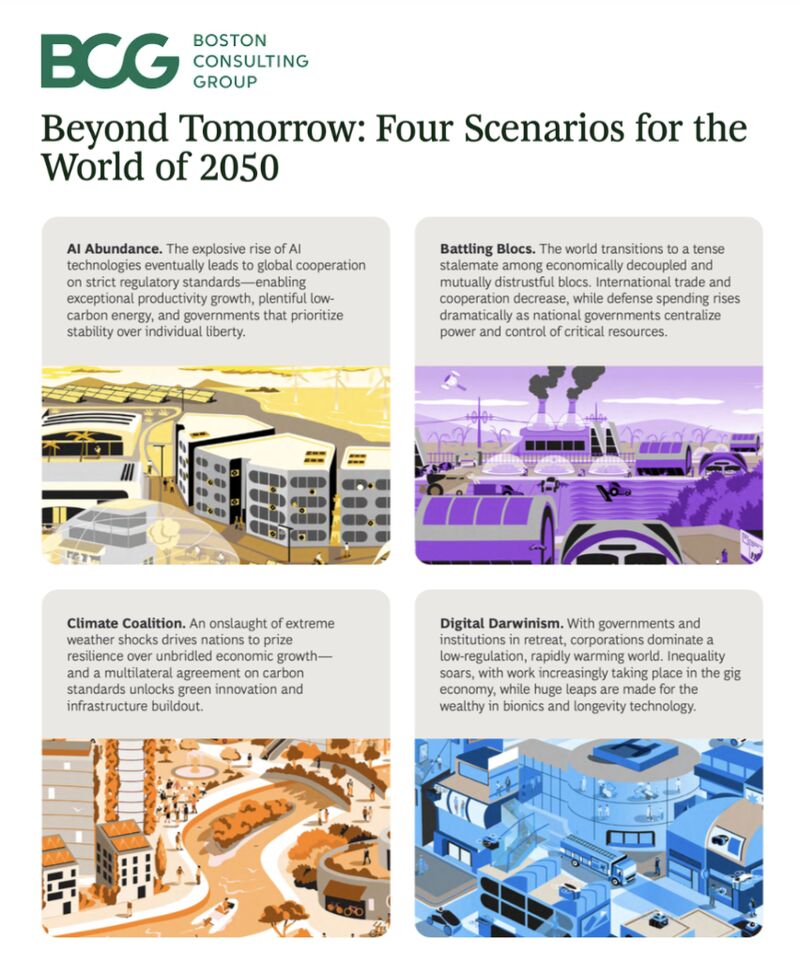
AI Abundance. Battling Blocs. Climate Coalition. Digital Darwinism. The BCG Henderson Institute gave the next 25 years four names – and every one of them rewrites how companies will hire, skill, and access the people who build their tech environments.
Most strategy still runs on a single, unspoken assumption: that tomorrow will look roughly like today, only more so. The BCG Henderson Institute’s report, Beyond Tomorrow: Four Scenarios for the World of 2050, makes the case that this is the one assumption no leader can afford. The only unacceptable strategy is planning for just one future.
BCG built the four scenarios on a quantitative analysis of more than a hundred megatrends, a century of historical data, and dozens of expert interviews, then stress-tested each across twenty economic, geopolitical, societal, and environmental metrics. These scenarios are a map of the plausible – and the spread between them is staggering.
At Zeren, we read futures work like this through one lens: talent. Because whichever of these four worlds we drift toward, each one reshapes the most important question our industry answers – how do companies get the right capabilities, in the right place, at the right moment? Here are the four scenarios in full, followed by what they mean for hiring and IT staff augmentation specifically.
1. AI Abundance – the regulated boom
The world. AI explodes, nearly breaks society, and is then reined in by global cooperation. In BCG’s telling, a wave of AI-enhanced cyberattacks in the 2030s – the “Compute Wars” – cripples hospitals, grids, and transport, affecting more than a billion people.
The result by 2050 is a genuine productivity miracle. Global GDP more than triples, driven not by population or globalization but by soaring productivity – high-income labor productivity grows at roughly 5.7% a year. Clean energy becomes cheap and plentiful, a robotics and “physical AI” revolution transforms manufacturing and services, and the average person works about 25% fewer hours than today – roughly 1,600 a year, down from 2,100, with four-day weeks common in many regions. Healthy life expectancy climbs from 63 to 70. Most nations build expanded safety nets or basic-income programs funded by automation taxes.
The catch is freedom. To combat misinformation, guardrails on digital platforms constrain civil society; governments quietly trade some individual liberty for stability. And the climate is hot – around 2.2°C above pre-industrial levels — though emissions are finally falling fast.
The tech talent earthquake. AI and robots displace much of what people used to do, and the wage premium for expertise erodes across many professions. New opportunity concentrates in three places: caring professions, AI oversight and judgment roles, and skilled manual trades. BCG’s sharpest warning is the rise of AI-only firms – networks of specialized AI agents that run with little or no human involvement, and that appear first in digital-native sectors with minimal physical interface: software development, digital marketing, algorithmic trading. In other words, Zeren’s industry’s heartland.
2. Battling Blocs – the fractured world
The world. Globalization goes into reverse. After a tariff war, a wave of nationalist leaders, splintering of the internet, the collapse of the WTO, and the hollowing-out of the UN, the world hardens into rigid, mutually distrustful blocs that prize security and self-sufficiency over collaboration. Trade falls back to Cold War levels — from 57% of global GDP to 35%. Defense spending nearly triples, from 2.4% to 7% of GDP.
The line between government and business blurs into state capitalism. Traditional multinationals all but disappear, forced to pick a bloc or juggle a fragile web of regional joint ventures. Innovation narrows to defense, dual-use technology, and bloc self-reliance, while consumer and health domains starve for investment. Growth stalls at 1.8% a year, productivity at just 1.0%. Democracies fall from 49% of countries to 25%. Worldwide happiness drops 10%, extreme poverty rises from 8% to 10%, and with multilateral climate action dead, warming still reaches 2.1°C.
The tech talent earthquake. This is the scenario where BCG states it most directly: talent becomes a scarce strategic asset and a dimension of great-power competition. Aging populations and restricted migration tighten labor markets; immigration policy shifts from a growth lever to a geostrategic weapon. The race for talent plays out across three fronts – capturing scientific and technical expertise, sustaining entrepreneurial clusters, and protecting the academic centers that train the next generation. Meanwhile, a non-aligned Global South – India projected to be the world’s third-largest economy by 2029, with Brazil, Indonesia, and others climbing fast – becomes a coveted source of young, expanding workforces.
3. Climate Coalition — resilience over growth
The world. A run of extreme weather events in the late 2020s – catastrophic flooding, deadly heat waves – triggers a global wave of citizen pressure for coordinated action. A “climate club” of industrial nations forms, requiring members to price carbon domestically and apply carbon border adjustments. By 2040 most major economies have joined; by 2050 carbon sells at $300 a ton. It works: warming stabilizes at 1.8°C, the share of unabated fossil fuels in the energy mix collapses from 81% to 35%, and low-carbon sources generate 92% of electricity.
But it’s a delicate balance. Taxes are high and spending is lean. Growth is slow but steady at 2.5% a year, dragged by aging societies and the fading dividends of globalization. The upside is broadly shared – extreme poverty is halved, from 8% to 4%. The friction is generational: with carbon revenues earmarked for restoration and pension liabilities heavy, working-age adults in advanced economies end up with less disposable income than retirees, and politics turns on intergenerational fairness.
The tech talent earthquake. Crucially, in this world AI is a support for humans, not a substitute – job losses happen, but they’re temporary because nations and companies invest continuously in upskilling and reskilling. Innovation pours into low-carbon energy, new materials, biotech, and agriculture, creating demand for entirely new skill profiles. And aging hits hard: labor shortages spread across the Global North, making aging-workforce strategy – late-career pathways, multigenerational teams, knowledge transfer between older and younger workers – a frontline competitive issue rather than an HR footnote.
4. Digital Darwinism — survival of the fittest
The world. The opposite of AI Abundance’s bargain. A race to the bottom on regulation unleashes tech companies, governments retreat, and a survival-of-the-fittest ethos takes hold. Growth is strong – global GDP grows 4% a year, near-tripling – and trade stays open out of commercial self-interest (61% of GDP). But the spoils are brutally concentrated: the richest 1% come to hold nearly half of global wealth, a level not seen since the early 1900s, while the middle class shrinks and extreme poverty climbs from 8% to 12%.
Work fractures into two tiers. Those with creative or high-skill expertise thrive; everyone else faces stagnant prospects, gig-style and short-term contracts mediated by algorithmic platforms, AI “cobots” that double as surveillance, and an epidemic of digital overload, burnout, and addiction. Knowledge gets locked inside megacorporations, eventually dampening the pace of innovation. Democracies fall to 30% of countries. With decarbonization sidelined for adaptation that mostly protects wealthy enclaves, warming hits 2.5°C.
The tech talent earthquake. This is the staff-augmentation model taken to a dystopian extreme: contingent, algorithmically-brokered, commoditized labor at civilizational scale, stripped of security and stability. In a low-trust, cutthroat environment, BCG argues that trust itself — auditable governance, provenance, cyber resilience, genuine investment in people — becomes one of the few durable differentiators. Multitier offerings emerge everywhere: premium for the elite, bare-bones for the mass market.
What the four scenarios mean for hiring and IT staff augmentation
Read together, the four worlds deliver a striking verdict for our industry: the demand for flexible, on-demand access to specialized talent doesn’t just survive in every scenario – it intensifies.
In AI Abundance, the commodity layer evaporates — and the judgment layer becomes gold. If AI-only firms can spin up in software development and digital marketing first, then supplying generic “three backend developers for six months” is the part of our business most exposed to automation. But the same scenario tells us exactly where human value migrates: agenda-setting, taste, assessment, oversight, empathy, and the orchestration of agentic workflows. The staff augmentation that wins here doesn’t sell seats; it sells AI-fluent architects, human-in-the-loop judgment, and the embedded leadership that helps a client become AI-first before an AI-only rival makes the choice for them. Reskilling stops being a perk and becomes the core product.
In Battling Blocs, location becomes destiny — and within-bloc nearshore talent becomes a strategic asset. When mobility tightens and data localizes, a client can no longer freely tap a global talent pool. They need capability inside their own bloc and jurisdiction. For an EU-anchored, Romania-based partner, this is structurally favorable: deep engineering talent, nearshore proximity to Western European clients, and shared regulatory ground at exactly the moment those things become scarce and valuable. The flip side is real — fragmentation makes cross-border sourcing harder and turns talent access into a geopolitical question — but in a bloc-based world, being inside the right bloc with the right people is a moat, not a footnote.
In Climate Coalition, the mandate is reskilling and demographics. Continuous upskilling is explicitly what keeps job losses temporary in this world, and chronic labor shortages across an aging Global North create durable, structural demand for flexible and specialized talent. Add the green-skills gap — climate-tech, energy software, MRV and carbon-accounting systems, new-materials engineering — and you have a market that needs partners who can both close skill gaps fast and design multigenerational, late-career-inclusive workforce models. This is the scenario most aligned with staff augmentation as a strategic capability rather than a stopgap.
In Digital Darwinism, trust is the only defensible margin. This world commoditizes contingent labor and pushes the whole industry toward a price-driven, platform-brokered race to the bottom – with worker wellbeing as collateral damage. The firms that don’t get commoditized are the ones that invest in the opposite: rigorous vetting, embedded delivery leadership, auditable quality, and a genuine duty of care to the people they place. The “pod and squad” model – cross-functional teams with embedded tech leads and delivery managers who own outcomes – is precisely the antidote to anonymous gig brokering. In a low-trust world, being the trusted name is the premium.
The through-line: BCG’s five low-regret moves
Across all four scenarios, BCG identifies five “low-regret” moves that make sense no matter which future arrives. One of them reads almost like a job description for the next era of our industry:
Reimagine talent for aging populations and AI – build models for intergenerational word, more flexible roles, and talent mobility; extend your talent footprint into emerging labor markets; and design new human-machine operating models that combine agentic AI workflows with human oversight, judgment, and creativity.
The other four reinforce the same direction of travel. Enhance structural resilience (diversify, build regional optionality). Build digital flexibility and trust (modular stacks, cybersecurity, verifiable systems). Sharpen sensing and influencing (foresight, faster decision loops). And embrace a broader societal role — because companies that look after workers’ wellbeing will, in BCG’s words, earn a premium in talent markets.
That last point matters most for an industry built on people. In a world where skills expire faster than ever and adaptability beats permanence in every scenario, the organizations that treat talent as a strategic system — not a cost line — are the ones positioned to win.
Where Zeren stands
Strip the four scenarios down to their common core and two truths hold in every one:
First, the half-life of skills keeps shrinking. Whether AI augments work, fragments it, greens it, or commoditizes it, no one builds a 2050-proof workforce by hiring once and standing still. Reskilling, redeployment, and flexible access to specialized tech capability move from “nice to have” to the center of workforce strategy.
Second, the value of getting the right tech capability, exactly when you need it rises in all four futures. That has always been the premise of staff augmentation – and these scenarios suggest the premise only gets stronger. What they also make clear is where the work has to move: up the value chain. Away from filling seats and toward outcome-aligned pods, embedded leadership, AI-fluent talent, and a trust standard that a platform can’t replicate.
That’s the bet we’re already making. We build tech talent models backwards from outcomes rather than forwards from job titles. We deploy cross-functional pods rather than scattered individuals. We treat embedded tech leads and delivery managers as the multiplier, not the overhead. And we work at the intersection of tech talent and human potential – because in every one of BCG’s four worlds, that intersection is exactly where durable advantage lives.
You can’t plan for a single version of 2050. But you can build the one capability that pays off in all of them: the ability to access, shape, and continually renew the tech talent your strategy depends on. That’s the future we’re preparing our clients — and ourselves — to thrive in.
Source: BCG Henderson Institute, “Beyond Tomorrow: Four Scenarios for the World of 2050” (April 2026). All scenario data and projections are BCG’s; the talent and staff-augmentation analysis is Zeren Software’s own.